

MikroTik hEX Refresh 2024 5-Port Gigabit Router ARM
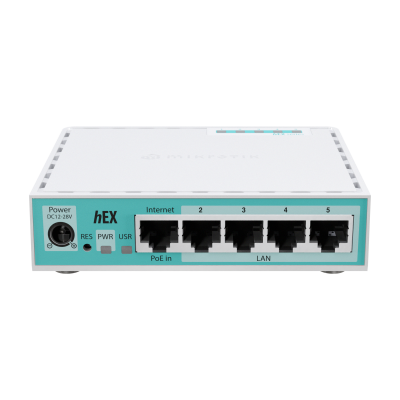
The MikroTik hEX refresh (2024) is the updated generation of MikroTik's most popular affordable wired router — 5 Gigabit Ethernet ports, dual-core ARM32 EN7562CT at 950 MHz, 512 MB RAM (doubled from the previous generation), 128 MB NAND, RouterOS v7 License 4, passive PoE-in and DC jack (12–28V), USB Type-A, passive cooling, IP20, -40°C to +70°C, MTBF ~100,000 hours at 25°C. CE, EAC, and RoHS certified. Includes 24V 0.38A power adapter. USD 59.95. The correct wired gateway router for home and small office deployments where Wi-Fi is handled by separate APs, routing performance matters, and the full RouterOS v7 feature set is required at the lowest available price point in the MikroTik router line-up.

We only offer IC Certified products. For international products, contact us.

Ship Charge Will Display As Free Until Ship Address / Location Is Provided To Calculate Ship Charge.
The MikroTik hEX refresh is not a rebadged previous-generation device with a new sticker. MikroTik's own description is precise on this point: the same price, twice the performance. The 2024 refresh replaces the previous hEX's MIPS CPU with a modern dual-core ARM32 EN7562CT running at 950 MHz, and doubles the RAM from 256 MB to 512 MB. MikroTik publishes the performance improvement explicitly — depending on configuration, the performance increase reaches 100–134% over the previous generation. At USD 59.95, the hEX refresh delivers the same price point as the previous hEX with a hardware platform that was not available at this price two years ago. For buyers who purchased the previous hEX and are considering an upgrade, or buyers who dismissed the hEX on CPU performance grounds, the refresh is a materially different device under the same product name and price.
The five Gigabit Ethernet ports are the core hardware specification — five physical ports, no SFP, no Wi-Fi, no LTE. RouterOS assigns WAN and LAN roles in software — one port as WAN (connected to the ISP modem or ONT), four ports as LAN switch. For multi-WAN deployments — dual ISP connections bonded or failed over — two ports are WAN and three are LAN. For VLAN-based network segmentation (separate VLANs for work, IoT, guest, and management traffic on a home or small office network), RouterOS manages VLAN tagging and routing across all five ports in software — the EN7523 switch chip handles the hardware-accelerated switching. The hEX refresh is a five-port wired router, not a switch — it routes, firewalls, and manages traffic between networks, it does not provide the flat Layer 2 switching that a CSS318 or other managed switch provides.
The dual-core ARM32 EN7562CT at 950 MHz with 512 MB RAM is the hardware combination that defines the hEX refresh's positioning in the MikroTik router line-up. 512 MB RAM — the same RAM capacity as the Chateau LTE18 ax and equal to many mid-range RouterBOARD devices — is a meaningful increase from the 256 MB of the previous generation. RouterOS v7 under full load — active firewall rules, multiple VPN tunnels, DHCP, DNS, and connection tracking — consumes RAM proportional to the number of concurrent connections and active features. For a home network with 30–60 connected devices and multiple active VPN sessions, 512 MB provides headroom that 256 MB does not. The ARM32 architecture also enables RouterOS v7's full feature set — including WireGuard VPN, which benefits from ARM's more efficient cryptographic instruction handling compared to previous-generation MIPS platforms.
IPsec performance is published separately by MikroTik on the product page (the IPsec test results are linked). For VPN-heavy deployments — site-to-site IPsec tunnels to branch offices or cloud infrastructure, or road warrior IPsec remote access — the EN7562CT's ARM architecture handles IPsec encryption and decryption more efficiently than the previous hEX MIPS platform. Confirm the IPsec throughput figures from MikroTik's published test results before specifying the hEX refresh for a high-throughput VPN use case — the hardware crypto engine capabilities of the EN7562CT should be confirmed from MikroTik's documentation.
The passive PoE-in (12–28V) is a deployment flexibility feature that is easy to overlook. A passive PoE-capable Ethernet cable from an upstream PoE injector or PoE switch port powers the hEX refresh without a separate DC power run — one cable carries both power and the upstream WAN connection to the router mounting location. For a hEX refresh mounted in a wall enclosure, a communications cabinet, or a location where running a separate DC power cable is inconvenient, passive PoE-in from an injector simplifies installation. The included 24V 0.38A power adapter provides the DC jack power option out of the box.
The USB Type-A port (1A max, USB Power Reset supported) provides two operational functions. First, USB storage — plug in a USB flash drive or USB hard drive and configure RouterOS's built-in file server or SMB share to provide network-attached storage across the LAN. MikroTik's product page explicitly names media streaming as a use case — a USB drive on the hEX refresh serves as a simple NAS for household media storage without a dedicated NAS device. Second, USB LTE modem support — a USB LTE dongle attached to the USB port provides cellular WAN backup connectivity, with RouterOS failover scripting switching to the LTE connection when the primary WAN connection fails. For a home or small office where ISP reliability is inconsistent, USB LTE backup is an affordable continuity option without dedicated LTE hardware.
Maximum power consumption is 10W under full load — 4W without attachments. The hEX refresh is one of the lowest-power five-port Gigabit routers in the MikroTik line-up. At 4W idle, it draws less power than a standard LED bulb and can run continuously for years at negligible electricity cost. For always-on home and small office routers, low idle power consumption is a meaningful 5-year total cost of ownership differentiator.
Passive cooling — no fan, no moving parts — means the hEX refresh runs silently and without fan failure risk. For a desktop or wall-mount installation in a living room, home office, or small business front office where fan noise is unacceptable, passive cooling is a meaningful purchasing consideration.
RouterOS v7 on License 4 is the full routing and network management platform — firewall, NAT, DHCP, DNS, WireGuard, IPsec, L2TP, OpenVPN, VLAN, QoS, scripting, SNMP, and the complete RouterOS feature set available from day one without licence tiers or subscription fees. License 4 covers all standard home and small office routing use cases. Software updates are included for the life of the product, guaranteed minimum 5 years from purchase.
**Canadian market note:** Certifications published are CE, EAC, and RoHS — no FCC or IC. The hEX refresh is a wired router with no wireless transmitter. IC certification requirements for wired routing equipment differ substantially from active wireless devices — the regulatory risk for a wired Ethernet router in the Canadian market is substantially lower. However, CE and EAC are European and Eurasian certifications. Confirm Canadian regulatory compliance with your MikroTik distributor before listing. No wireless transmitter makes this a low-regulatory-risk product for the Canadian market in practice.
Key specifications:
- **Architecture:** ARM 32-bit
- **CPU:** EN7562CT, dual-core ARM32, 950 MHz
- **Switch chip:** EN7523
- **RAM:** 512 MB
- **Storage:** 128 MB NAND
- **OS:** RouterOS v7, License 4
- **Ethernet:** 5× 10/100/1000 Mbps Gigabit Ethernet
- **PoE-in:** Passive PoE, 12–28V
- **DC jack input:** 12–28V
- **USB:** 1× USB Type-A, 1A max, USB Power Reset
- **Max power consumption:** 10W (with attachments), 4W (without)
- **Cooling:** Passive
- **IP rating:** IP20 (indoor installation only)
- **Operating temperature:** -40°C to +70°C
- **MTBF:** ~100,000 hours at 25°C
- **Monitors:** CPU temperature, PCB temperature, voltage
- **Mode button:** Yes
- **Dimensions:** 113 × 89 × 28 mm
- **Certifications:** CE, EAC, RoHS — no FCC, no IC published
- **Included:** 24V 0.38A power adapter
- **Product code:** E50UG
- **Suggested price:** USD 59.95
Note: Wired router only — no Wi-Fi. IP20 rated — indoor desktop or enclosure installation only. Passive PoE-in is 12–28V — not 802.3af/at active PoE. Confirm passive PoE voltage compatibility with your PoE source before connecting.

- Product code
- E50UG
- Architecture
- ARM
- CPU core count
- 2
- CPU nominal frequency
- 950 MHz
- Switch chip model
- EN7562CT
- Operating System
- RouterOS
- Size of RAM
- 512 MB
- Storage size
- 128 MB NAND
- Tested ambient temperature
- -40 + 70 C
- Number of DC inputs
- 2 (DC jack, PoE-IN)
- DC jack input Voltage
- 12-28 V
- Max Power consumption
- 4W
10 W - PoE in
- Passive PoE
- PoE in input Voltage
- 12-28 V
- 10/100/1000 Ethernet ports
- 5
- Dimensions
- 113x89x28mm
- Number of USB ports
- 1
- USB slot type
- USB type A
- Max USB current (A)
- 1
- Nominal current
- 0.38 A