
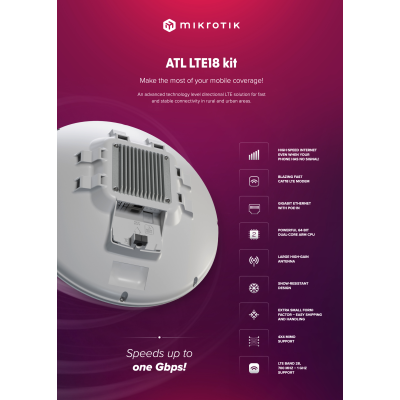


MikroTik ATL LTE18 Kit Cat18 4×4 MIMO Outdoor Router
The MikroTik ATL LTE18 kit (ATLGM&EG18-EA) is a directional outdoor LTE Cat18 router — dual-core ARM64 Marvell 88F3720 at 800 MHz, 256 MB RAM, 16 MB FLASH, RouterOS v7 License 3, LTE Cat18 1.2 Gbps DL / 150 Mbps UL, 4×4 MIMO DL / 1×1 UL, FDD bands 1/3/5/7/8/20/28 + TDD bands 38/40/41, 3G R8, 1× Micro SIM, 1× M.2 slot, 4× high-gain mid-band antennas (1.7–2.7 GHz) + 2× high-gain low-band antennas (700MHz–1GHz, Band 28), 1× Gigabit Ethernet PoE-in 802.3af/at 12–57V, passive cooling, IP54, -40°C to +70°C, MTBF ~200,000 hours. CE, EAC, RoHS — no FCC, no IC. Includes 24V 0.8A adapter, Gigabit PoE injector, hose clamp ×2. USD 279.00.

We only offer IC Certified products. For international products, contact us.

Ship Charge Will Display As Free Until Ship Address / Location Is Provided To Calculate Ship Charge.
The MikroTik ATL LTE18 kit is MikroTik's highest-category LTE CPE — a directional outdoor unit built around LTE Category 18, 4×4 MIMO downlink, and a purpose-engineered antenna array that separates low-band and mid-band antenna elements for maximum signal gain across the full LTE frequency range. It is designed for one specific job: extracting the maximum possible throughput from an LTE base station at distance.
**LTE Category 18 — carrier aggregation up to 1.2 Gbps**
LTE Cat18 is the highest LTE category in MikroTik's current lineup. Cat18 supports up to 5-carrier downlink aggregation with 4×4 MIMO per carrier — theoretical peak 1.2 Gbps downlink, 150 Mbps uplink. Where Cat6 aggregates two carriers and Cat12 aggregates three, Cat18 aggregates up to five simultaneously — making full use of operators deploying multi-carrier LTE Advanced Pro networks in urban and suburban environments. Combined with the Gigabit Ethernet PoE-in port and the Marvell 88F3720 ARM64 CPU, MikroTik explicitly states "speeds up to 1 Gbps, no bottlenecks" — the Ethernet port and CPU are not the limiting factor.
**4×4 MIMO DL + separated antenna architecture**
The ATL's defining hardware feature is its 6-element separated antenna array: 4× high-gain mid-band antennas covering 1.7–2.7 GHz (Bands 1/3/7/38/40/41) and 2× high-gain low-band antennas covering 700MHz–1GHz (Bands 5/8/20/28). Dedicated low-band antennas are optimised for the physical characteristics of sub-1GHz radio waves — larger effective aperture, directional gain toward the tower — rather than forcing a single wideband antenna to compromise across a 4:1 frequency range. Band 28 (700MHz) is used by Bell, Rogers, and Telus in Canada; Band 20 (800MHz) covers European operators. The low-band coverage makes the ATL effective in rural areas where the nearest LTE tower may be several kilometres distant and only low-band signals reach reliably.
**Spaceship enclosure — snow and ice shedding**
The ATL's distinctive curved enclosure geometry is a functional design decision. MikroTik's own description: "this design prevents snow and water from collecting and freezing up." Flat-faced outdoor antenna units accumulate snow on their front face, which attenuates the RF signal and eventually causes physical stress from ice weight. The ATL's curved profile sheds precipitation by gravity — no manual cleaning required in winter deployments. For a Canadian rooftop, tower, or building facade installation in a northern climate, this is an operationally meaningful design advantage over flat-panel LTE CPE.
**M.2 slot — modem upgradeability**
The single M.2 slot is the ATL's future-proofing provision — the EG18-EA Cat18 modem is the installed module, but the M.2 interface allows replacement with a compatible M.2 LTE or 5G modem as operator networks evolve. For a fixed rural installation where the ATL is permanently mounted at height, the M.2 upgradeable modem avoids a full hardware replacement when upgrading to a higher-category or 5G module.
**5-year software support guarantee:** RouterOS v7 updates free for life of product or minimum 5 years from date of purchase.
**Canadian market advisory:** CE, EAC, RoHS only — no FCC, no IC (ISED) certification published. Band 28 (700MHz) and Band 7 (2600MHz) overlap with Canadian carriers (Bell/Rogers/Telus). Confirm specific carrier band compatibility and ISED certification status before listing or recommending for Canadian deployments.
Key specifications:
- **Product code:** ATLGM&EG18-EA
- **CPU:** Marvell 88F3720, dual-core ARM64, 800 MHz
- **RAM / Storage:** 256 MB / 16 MB FLASH
- **OS:** RouterOS v7, License 3
- **LTE:** Cat18, 1.2 Gbps DL / 150 Mbps UL, 4×4 MIMO DL / 1×1 UL
- **LTE FDD bands:** 1, 3, 5, 7, 8, 20, 28
- **LTE TDD bands:** 38, 40, 41
- **3G:** R8, bands 1/3/5/8
- **SIM:** 1× Micro SIM
- **M.2 slot:** 1×
- **Antennas:** 4× mid-band (1.7–2.7 GHz) + 2× low-band (700MHz–1GHz)
- **GbE ports:** 1× (PoE-in 802.3af/at, 12–57V)
- **Max power:** 8W
- **Cooling:** Passive
- **IP rating:** IP54
- **Operating temp:** -40°C to +70°C
- **MTBF:** ~200,000 hours at 25°C
- **Certifications:** CE, EAC, RoHS — no FCC, no IC
- **Included:** 24V 0.8A adapter, Gigabit PoE injector, hose clamp ×2
- **Suggested price:** USD 279.00

- Product code
- ATLGM&EG18-EA
- Architecture
- ARM 64bit
- CPU
- Dual-core 88F3720 1.2 GHz
- Operating System
- RouterOS, License level 3
- Size of RAM
- 256 MB
- Storage size
- 16 MB
- Storage type
- Flash
- Number of DC inputs
- PoE-in (12-57)
- Max Power consumption
- 8 W
- Max power consumption without attachments
- 8 W
- PoE in
- PoE-in (12-57)
- 3G Category
- R8 (42.2Mbps Downlink, 11.2Mbps Uplink)
- 3G bands
- 1 (2100MHz) / 3 (1800MHz) / 5 (850MHz) / 8 (900MHz)
- 10/100/1000 Ethernet ports
- 1
- Dimensions
- 315 mm diameter x 170 mm depth
- LTE Category
- 18 (1.2Gbps Downlink, 150Mbps Uplink)
- TAC
- 86981604
- Operating Temperature
- -40°C to +70°C
- Bands
- 1 (2100MHz) / 3 (1800MHz) / 5 (850MHz) / 7 (2600MHz) / 8 (900 MHz) / 20 (800MHz) / 28 (700MHz) / 38 (2600MHz) / 40 (2300MHz) / 41 (2500MHz)
- RAM type
- DDR3L
- LTE modem
- R11mL-EG18-EA