

MikroTik SXT LTE7 Kit Cat7 300Mbps Outdoor LTE CPE
The MikroTik SXT LTE7 kit (SXTR&R11e-LTE7) is a rugged outdoor LTE Category 7 CPE — single-core MIPSBE QCA9531 at 650 MHz, 64 MB RAM, 16 MB FLASH, RouterOS v7 License 3, built-in R11e-LTE7 miniPCIe LTE Cat7 modem (DL: 300 Mbps / UL: 100 Mbps, 2×2 DL MIMO, carrier aggregation), 2× Micro-SIM slots, 1× miniPCIe slot, LTE FDD bands 1/3/5/7/8/20/28/32 + LTE TDD bands 38/40/41, 3G R8 fallback, 2× 10/100 Ethernet (Ether1: 802.3af/at PoE-in 12–57V; Ether2: passive PoE-out up to 57V 600 mA), 24W max consumption, passive cooling, IP54, -40°C to +60°C, MTBF ~200,000 hours at 25°C. CE, EAC, RoHS certified. Includes 24V 1.2A power adapter, metal ring, pole mounting bracket, PoE injector.
Product customization
Don't forget to save your customization to be able to add to cart

We only offer IC Certified products. For international products, contact us.

Ship Charge Will Display As Free Until Ship Address / Location Is Provided To Calculate Ship Charge.
The MikroTik SXT LTE7 kit is MikroTik's latest generation outdoor LTE CPE — an evolution of the trusted SXT platform that has shipped in thousands of rural, agricultural, and remote site deployments worldwide, now upgraded with the R11e-LTE7 LTE Category 7 modem for substantially faster downloads, better uplink, and carrier aggregation capability that materially improves performance in both congested urban LTE environments and weak-signal rural locations.
**The R11e-LTE7 modem — what Cat7 means in practice**
The R11e-LTE7 is MikroTik's next-generation miniPCIe LTE modem — a drop-in upgrade from the previous FG621-EA modem with a smaller form-factor and significantly expanded capabilities. Understanding what LTE Category 7 delivers versus the previous LTE Category 4 (DL: 150 Mbps) makes the upgrade case clear:
- **DL: 300 Mbps / UL: 100 Mbps theoretical maximum:** LTE Cat7 doubles the Category 4 downlink ceiling from 150 Mbps to 300 Mbps and doubles the uplink from 50 Mbps to 100 Mbps. The uplink improvement is particularly meaningful for the SXT LTE7 kit's target use cases — farms uploading field sensor data, security camera systems sending video to a central NVR, remote workers uploading large files. LTE Cat4's 50 Mbps uplink ceiling was a frequent operational constraint; Cat7's 100 Mbps uplink ceiling removes it in most real-world deployments.
- **2×2 DL MIMO:** Two simultaneous receive chains on the downlink — the SXT LTE7 kit receives two independent spatial streams from the LTE base station simultaneously, combining them for higher throughput and better reliability in multipath environments. The SXT enclosure's integrated antenna design is calibrated for 2×2 MIMO operation on the LTE bands.
- **1×1 UL MIMO:** Single transmit chain on the uplink — standard for LTE Cat7 devices. Uplink throughput improvement in Cat7 comes from higher modulation order (64-QAM uplink vs Cat4's 16-QAM) rather than MIMO spatial streams.
- **Carrier aggregation (CA):** The R11e-LTE7's carrier aggregation capability allows the modem to simultaneously use multiple LTE frequency bands — for example, Band 3 (1800 MHz) and Band 7 (2600 MHz) simultaneously — combining their bandwidth into a single higher-throughput connection. MikroTik's own product page states that carrier aggregation has delivered internet speed doubling in rural deployments compared to single-band LTE connections. In areas where the local LTE tower broadcasts on multiple bands, the SXT LTE7 kit automatically aggregates available bandwidth rather than connecting to a single band — a passive performance improvement requiring no operator configuration.
- **Band 28 (700 MHz) support:** Band 28 is the primary rural and regional LTE coverage band in Canada — both Rogers and Bell deploy Band 28 for extended rural coverage, leveraging 700 MHz's superior propagation characteristics over higher-frequency bands. For the SXT LTE7 kit's primary use case — farms, rural estates, off-grid sites, and remote locations — Band 28 support is the single most important LTE band specification. A device without Band 28 may have no LTE service at rural Canadian tower sites that operate exclusively on Band 28. Band 28 support confirmed on the R11e-LTE7.
- **Band 32 (1500 MHz) support:** Band 32 is an supplemental downlink (SDL) band used by some European carriers for additional downlink capacity. Less relevant for Canadian deployments but confirmed supported by the R11e-LTE7.
- **3G R8 fallback (DL: 42.2 Mbps / UL: 5.76 Mbps):** HSPA+ 3G fallback on Bands 1/3/5/8 ensures the SXT LTE7 kit maintains a data connection at sites where LTE coverage is absent but 3G coverage exists — a meaningful reliability safety net for remote Canadian deployments near the edge of LTE coverage.
**LTE band coverage for Canadian carriers**
The R11e-LTE7's LTE FDD band set covers the primary Canadian carrier LTE bands:
- **Rogers:** Band 4 (AWS-1, 1700/2100 MHz) is not listed — confirm Rogers Band 4 compatibility from the R11e-LTE7 brochure. Band 7 (2600 MHz), Band 12/17 (700 MHz A/B), and Band 28 (700 MHz APT) are supported. Rogers also uses Band 66 (AWS-3) — confirm from brochure.
- **Bell / Telus (shared network):** Band 7 (2600 MHz), Band 17 (700 MHz B), Band 28 (700 MHz APT) supported. Bell/Telus Band 4 (AWS-1) — confirm from brochure.
- **Rogers / Bell / Telus Band 66 (AWS-3, 1700/2100 MHz):** Not explicitly listed on the product page — confirm from R11e-LTE7 brochure or MikroTik band compatibility documentation before listing for Canadian customers.
**Critical advisory for Canadian customers:** Confirm Band 4 (AWS-1, 1700/2100 MHz) and Band 66 (AWS-3) compatibility with your MikroTik distributor or from the R11e-LTE7 regulatory brochure before deploying the SXT LTE7 kit on Rogers or Bell/Telus networks in Canada. Band 28 (700 MHz) is confirmed supported and is the primary rural coverage band for all three major Canadian carriers.
**Dual Micro-SIM slots — redundancy and carrier flexibility**
Two independent Micro-SIM slots are a hardware feature that directly addresses the single largest operational risk of LTE-dependent remote site connectivity: carrier outage or SIM failure. With two SIM slots, the operator installs SIM cards from two different carriers — for example, Bell and Rogers — and configures RouterOS to automatically fail over to the secondary SIM when the primary carrier's connection fails. For a farm, remote monitoring station, or rural estate where LTE connectivity is the only available internet path, dual-SIM redundancy with automatic failover is a meaningful operational continuity improvement over single-SIM devices. RouterOS's scripting environment supports SIM slot switching via modem AT commands, allowing automatic or scripted failover between SIM slots based on signal quality, data session failure, or scheduled switching.
**PoE-in and PoE-out architecture**
The SXT LTE7 kit's dual Ethernet port architecture provides both PoE-in and PoE-out:
- **Ether1 PoE-in (802.3af/at, 12–57V):** The primary power input — a single Ethernet cable from a PoE injector or PoE switch port carries both the network uplink and power to the SXT LTE7 kit. The wide 12–57V input range covers passive PoE at 12V, 24V, and 48V as well as standard 802.3af (48V) and 802.3at (54V) active PoE. The included 24V 1.2A power adapter and PoE injector provide out-of-box powering from a standard non-PoE Ethernet source.
- **Ether2 passive PoE-out (up to 57V, 600 mA LV / 400 mA HV):** The SXT LTE7 kit can power a co-located downstream Ethernet device from Ether2 — a compact IP camera, a sensor node, a serial-to-Ethernet converter, or any device accepting passive PoE at the input voltage available on Ether2. The passive PoE-out voltage mirrors the input voltage — confirm downstream device's acceptable PoE input voltage before connecting to Ether2. This PoE-out capability simplifies cabling at remote sites where a second device needs power at the same mounting location as the SXT LTE7 kit.
**RouterOS v7 on the SXT LTE7 kit**
RouterOS v7 License 3 provides the routing, firewall, NAT, DHCP, and VPN feature set appropriate for a remote site CPE:
- **PPPoE / DHCP WAN client:** The LTE modem interface is managed by RouterOS as a standard WAN interface — RouterOS handles APN configuration, data session management, and reconnection automatically. For carriers requiring APN-specific configuration (Bell's ltedata.apn.bell.ca, Rogers' ltedata.rogers.com, Telus' isp.telus.com), RouterOS's modem interface APN settings are configured once at deployment.
- **NAT and firewall:** RouterOS NAT allows all devices on the local network behind the SXT LTE7 kit to share the LTE connection's public or carrier-NAT IP address. RouterOS firewall rules protect downstream devices from unsolicited inbound traffic on the LTE interface.
- **WireGuard VPN:** RouterOS v7's native WireGuard implementation allows the SXT LTE7 kit to establish an encrypted VPN tunnel from the remote site back to a central RouterOS infrastructure over the LTE connection — providing secure remote access to the site's local network and devices regardless of carrier NAT or dynamic IP address assignment.
- **DNS and DHCP server:** The SXT LTE7 kit serves as the local DNS resolver and DHCP server for all devices on the downstream local network — providing complete router functionality from the outdoor CPE without a separate indoor router.
- **SNMP monitoring:** RouterOS SNMP allows central monitoring of the SXT LTE7 kit's LTE signal quality (RSRP, RSRQ, SINR), data session state, Ethernet interface statistics, and system health from a central NMS — critical for managing fleets of SXT LTE7 kit units across multiple remote sites.
**SXT enclosure — proven outdoor form factor**
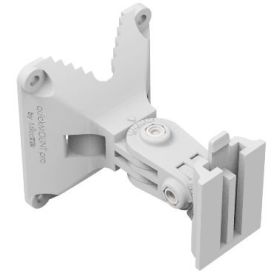
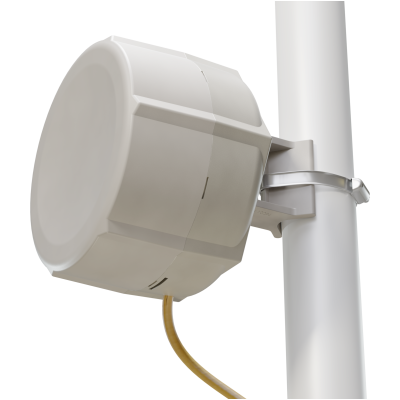
MikroTik's SXT enclosure is one of the most field-proven outdoor CPE form factors in the MikroTik portfolio — the same enclosure has been used across multiple SXT generations. The IP54 weatherproofing provides dust protection and water splash resistance from any direction — suitable for pole-mounted outdoor installations in rain, snow, and ice. The -40°C to +60°C operating temperature covers Canadian outdoor conditions, with the +60°C upper limit slightly lower than the CME Gateway and LtAP outdoor devices. The included pole mounting bracket and metal ring allow standard pole or mast mounting at a tower, rooftop, or building exterior. The compact, discreet enclosure profile — MikroTik explicitly highlights "designed to attract less unwanted attention" — is a practical consideration for rural site deployments where equipment theft or vandalism risk exists.
**Canadian market note — IC certification not confirmed:** Certifications published are CE, EAC, and RoHS only — no FCC or IC (ISED) certification is listed on either the SXT LTE7 kit or the R11e-LTE7 modem product pages. The SXT LTE7 kit is an active LTE radio device. IC (ISED) certification is required for legal sale and operation in Canada. This is a critical advisory for a Canadian reseller — confirm IC certification status for both the SXT LTE7 kit enclosure and the R11e-LTE7 modem with your MikroTik distributor before listing or selling to Canadian customers. The absence of IC certification on the product page may reflect a pending certification or a regional sales restriction. Do not list for Canadian sale until IC certification is confirmed.
Key specifications:
- **Product code:** SXTR&R11e-LTE7
- **Internal modem:** R11e-LTE7 (miniPCIe, LTE Cat7)
- **Architecture:** MIPSBE
- **CPU:** QCA9531, single-core, 650 MHz
- **Switch chip:** QCA9531
- **RAM:** 64 MB
- **Storage:** 16 MB FLASH
- **OS:** RouterOS v7, License 3
- **LTE modem:** R11e-LTE7, miniPCIe, LTE Category 7
- **LTE downlink:** 300 Mbps (Cat7), 2×2 MIMO
- **LTE uplink:** 100 Mbps (Cat7), 1×1
- **Carrier aggregation:** Yes
- **LTE FDD bands:** 1 (2100 MHz), 3 (1800 MHz), 5 (850 MHz), 7 (2600 MHz), 8 (900 MHz), 20 (800 MHz), 28 (700 MHz), 32 (1500 MHz)
- **LTE TDD bands:** 38 (2600 MHz), 40 (2300 MHz), 41 (2500 MHz)
- **3G fallback:** R8, DL 42.2 Mbps / UL 5.76 Mbps, Bands 1/3/5/8
- **SIM slots:** 2× Micro-SIM
- **miniPCIe slots:** 1×
- **Ethernet:** 2× 10/100 Mbps (Ether1: 802.3af/at PoE-in 12–57V; Ether2: passive PoE-out)
- **PoE-in:** 802.3af/at, 12–57V (Ether1)
- **PoE-out:** Passive PoE up to 57V, 600 mA LV / 400 mA HV (Ether2)
- **Max power consumption:** 24W
- **Max power without attachments:** 7W
- **Cooling:** Passive
- **IP rating:** IP54
- **Operating temperature:** -40°C to +60°C
- **MTBF:** ~200,000 hours at 25°C (SXT kit); ~100,000 hours at 25°C (R11e-LTE7 modem)
- **Certifications (SXT kit):** CE, EAC, RoHS — no FCC, no IC confirmed
- **Certifications (R11e-LTE7):** CE, RoHS — no FCC, no IC confirmed
- **Included:** 24V 1.2A power adapter, metal ring (one), pole mounting bracket, PoE injector
- **Suggested price:** USD 109.00

- Product code
- SXTR&FG621-EA
- Architecture
- MIPSBE
- CPU
- QCA9531 650 MHz
- CPU core count
- 1
- Operating System
- RouterOS v7, License level 3
- Size of RAM
- 64 MB
- Storage type
- 16 MB, Flash
- Number of DC inputs
- 1
- PoE in
- Yes, on Ether1
- 3G Category
- R8 (42.2Mbps Downlink, 11.2Mbps Uplink)
- 10/100 Ethernet ports
- 2
- Dimensions
- 140 x 140 x 56 mm
- MiniPCI-e slots
- 1
- LTE Category
- 6 (300Mbit/s Downlink, 50Mbit/s Uplink)
- LTE FDD bands
- 1 (2100MHz) / 3 (1800MHz) / 5 (850MHz) / 7 (2600MHz) / 8 (900MHz) / 20 (800 MHz) / 28 (700MHz)
- LTE TDD bands
- 38 (2600MHz) / 40 (2300MHz) / 41 (2500MHz)
- TAC
- 86335904
- Operating Temperature
- -40°C to +60°C
- RAM type
- DDR2
- LTE modem
- R11eL-FG621-EA