
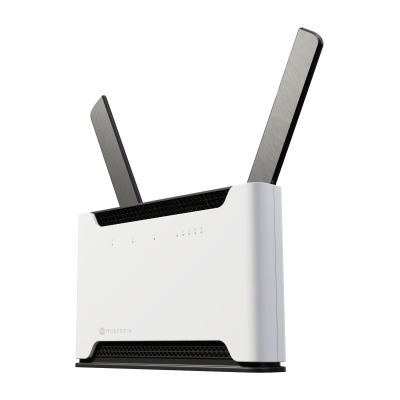


MikroTik Chateau LTE18 ax CAT18 Wi-Fi 6 Home LTE Router
The MikroTik Chateau LTE18 ax is the Generation 6 flagship home and office LTE router — CAT18 LTE delivering up to 1.2 Gbps downlink with 4×4 MIMO, dual-band Wi-Fi 6 (574 Mbps at 2.4 GHz, 1,200 Mbps at 5 GHz), four Gigabit Ethernet ports plus a 2.5 Gigabit Ethernet port, 4 built-in LTE antennas with 2 optional external antenna ports, quad-core ARM64 IPQ-6010 at 1.8 GHz, 1 GB RAM, WPA3, USB-A, RouterOS v7 License 4, -40°C to +65°C. Single DC jack input (12–28V), passive cooling, 19W max, 240 × 156 × 44 mm. Includes 24V 1.2A adapter and 1.5m UTP flat cable. The complete LTE home router for households and small offices replacing fixed broadband with a single, elegant device.

We only offer IC Certified products. For international products, contact us.

Ship Charge Will Display As Free Until Ship Address / Location Is Provided To Calculate Ship Charge.
The MikroTik Chateau LTE18 ax is the answer to a question that is increasingly relevant for Canadian households and small businesses: what happens when fibre or cable does not reach your address — or when LTE has already become faster than the fixed broadband available? The Chateau LTE18 ax is designed to be the only router in the building. Not a gateway bridged to a separate router. Not a modem with a Wi-Fi add-on. One device, mounted on a surface or sitting on a desk in any room, handling LTE uplink, Wi-Fi 6 distribution, wired Ethernet switching, USB storage, VPN, firewall, and QoS — under RouterOS v7 with a simple web interface for households who never open a terminal, and the full RouterOS feature depth for sysadmins who want to use every capability the platform provides.
The Generation 6 designation is not marketing — it marks three specific hardware upgrades over the previous Chateau LTE18: Wi-Fi 6 replaces Wi-Fi 5, the CPU upgrades to the quad-core IPQ-6010 at 1.8 GHz with 1 GB RAM, and a 2.5 Gigabit Ethernet port is added to the four existing Gigabit ports. Each upgrade addresses a specific bottleneck. Wi-Fi 6 eliminates the throughput ceiling of Wi-Fi 5 for households with many simultaneous connected devices. The IPQ-6010 at 1.8 GHz with 1 GB RAM handles IPsec hardware encryption, complex firewall rules, VPN tunnels, and advanced RouterOS scripting at full line rate — without the CPU saturation that limited previous-generation MIPS platforms under heavy load. The 2.5 Gigabit Ethernet port future-proofs the wired LAN — when 2.5G NAS drives, 2.5G switches, and 2.5G desktop NICs become standard, the Chateau LTE18 ax is already ready.
The CAT18 LTE modem is the same EG18-EA platform used in the LHG LTE18 kit — 1.2 Gbps downlink, 150 Mbps uplink, 4×4 MIMO on the downlink, 1×1 on the uplink. Four built-in LTE antennas are integrated into the Chateau's body, providing spatial diversity for the 4×4 MIMO receive chains without any external antenna requirement for standard deployments. Two optional external LTE antenna ports are provided for installations where the device is located inside a metal enclosure, a basement, or a signal-poor interior location — attach external LTE antennas to the available SMA ports to recover the signal level that the interior location is attenuating. MikroTik's own confirmation: the external antenna ports deliver exceptional coverage across the whole home.
The Wi-Fi 6 performance upgrade is documented in MikroTik's own comparison data: up to 40% higher throughput in the 5 GHz band and up to 90% higher throughput in the 2.4 GHz band versus the previous Chateau generation running Wi-Fi 5 and Wi-Fi 4 respectively. The improvement is not solely raw speed — Wi-Fi 6 introduces OFDMA (simultaneous multi-client scheduling), MU-MIMO (multi-user spatial streams), BSS colouring (interference mitigation in dense Wi-Fi environments), and Target Wake Time (battery life improvement for IoT and mobile clients). For a household with 20–50 connected devices — phones, laptops, tablets, smart TVs, IoT sensors, smart speakers — Wi-Fi 6 delivers measurably better per-device performance under concurrent load compared to Wi-Fi 5, not just higher peak speed on a single client.
The 2.4 GHz radio (802.11b/g/n/ax, QCN-5022, 2-chain, 574 Mbps max, 3 dBi) provides whole-home Wi-Fi 6 coverage at 2.4 GHz — the band that penetrates walls, floors, and building materials that attenuate 5 GHz signals. The 5 GHz radio (802.11a/n/ac/ax, QCN-5052, 2-chain, 1,200 Mbps max, 6 dBi) delivers high-throughput Wi-Fi 6 to nearby clients — laptops, desktop workstations, gaming consoles, and streaming devices in the same room or adjacent rooms. Together, the dual-band Wi-Fi 6 system covers both range and throughput requirements without mesh extensions or Wi-Fi repeaters in most residential and small office environments.
WPA3-PSK and WPA3-EAP security bring the Chateau LTE18 ax to the current standard for Wi-Fi protection — brute-force resistance, forward secrecy, and protection against deauthentication attacks that are trivially executable against WPA2 networks. For households running smart home devices, home office VPNs, and financial applications over the same Wi-Fi network, WPA3 is the minimum responsible security configuration in 2026.
RouterOS v7 on License 4 is the software platform. MikroTik's own framing is accurate and relevant: no paywalls, no subscriptions, no feature tiers. Every capability — VPN (WireGuard, IPsec, L2TP, OpenVPN), parental controls, QoS, complex firewall rules, VLAN, TR-069 operator management, SMS and email notifications, advanced scripting — is included in the pre-installed licence. The IPQ-6010's onboard hardware encryption engine accelerates IPsec at line rate — remote workers running a site-to-site IPsec VPN tunnel from the Chateau LTE18 ax back to a corporate office will not observe a throughput penalty from the VPN overhead on the LTE uplink.
TR-069 support makes the Chateau LTE18 ax a practical option for Canadian mobile operators and ISPs deploying LTE home routers to residential subscribers. The operator can remotely manage, provision, configure, and diagnose the device through the same TR-069 management infrastructure used for DSL and cable modem fleets — without requiring a truck roll for configuration changes. Custom branding and label printing are explicitly supported by MikroTik for operator deployments. For Canadian WISPs and MVNOs using the Chateau LTE18 ax as a CPE (Customer Premises Equipment) device, this is a genuine operational cost reduction.
The physical design is explicitly positioned for living spaces — 240 × 156 × 44 mm, elegant enough for a desk, shelf, or media cabinet in a traditional home, luxury residence, modern office, or corporate environment. MikroTik's own LMT Latvia deployment validated this positioning: operator clients preferred the Chateau over established consumer router brands on speed, stability, and flexibility. Passive cooling (no fan) means no noise — relevant for bedroom, home office, and quiet workspace installations. The included 1.5m UTP flat cable allows the router to be placed anywhere within 1.5m of the wall socket without requiring cable management for the LAN connection.
The single DC jack input (12–28V) is deliberately simple — one power cable, one adapter, no PoE infrastructure required. For a home deployment, this is the correct power architecture. Maximum power consumption is 19W with attachments (16W without) — lower than many consumer router platforms at this performance tier.
Key specifications:
- **LTE modem:** EG18-EA, CAT18 — 1.2 Gbps DL / 150 Mbps UL, 4×4 MIMO DL, 1×1 UL
- **LTE FDD bands:** 1 (2100 MHz), 3 (1800 MHz), 5 (850 MHz), 7 (2600 MHz), 8 (900 MHz), 20 (800 MHz), 28 (700 MHz)
- **LTE TDD bands:** 38 (2600 MHz), 40 (2300 MHz), 41 (2500 MHz)
- **3G:** Category R8, 42.2 Mbps DL / 11.2 Mbps UL — bands 1, 3, 5, 8
- **LTE antennas:** 4 built-in, 2 optional external antenna ports
- **Wi-Fi 2.4 GHz:** 802.11b/g/n/ax, Wi-Fi 6, 2-chain, 574 Mbps max, 3 dBi, QCN-5022
- **Wi-Fi 5 GHz:** 802.11a/n/ac/ax, Wi-Fi 6, 2-chain, 1,200 Mbps max, 6 dBi, QCN-5052
- **Wi-Fi security:** WPA3-PSK, WPA3-EAP
- **Ethernet:** 4× 10/100/1000 Mbps + 1× 2.5 Gigabit Ethernet
- **USB:** 1× USB Type-A, 1A max, USB Power Reset supported
- **SIM:** 1× Micro SIM (not included)
- **Power input:** DC jack 12–28V
- **Max power consumption:** 19W (with attachments), 16W (without)
- **Cooling:** Passive
- **CPU:** IPQ-6010, quad-core ARM64, 864–1,800 MHz
- **RAM:** 1 GB
- **Storage:** 128 MB NAND
- **OS:** RouterOS v7, License 4
- **Dimensions:** 240 × 156 × 44 mm
- **IP rating:** IP20 (indoor installation only)
- **Operating temperature:** -40°C to +65°C
- **MTBF:** ~200,000 hours at 25°C
- **Certifications:** CE, EAC, RoHS — no FCC, no IC published
- **Included:** 24V 1.2A power adapter, 1.5m UTP flat cable
- **Product code:** S53UG+5HaxD2HaxD-TC&EG18-EA
Note: SIM card not included — LTE connectivity requires a Micro SIM from a compatible carrier. IP20 rated — indoor installation only. Confirm LTE band compatibility with your Canadian carrier before purchase. Band 4 (AWS) is not listed in the published LTE FDD band table — confirm with your distributor for Canadian carrier compatibility.

- Product code
- S53UG+5HaxD2HaxD-TC&EG18-EA
- Architecture
- ARM 64bit
- CPU
- IPQ-6010
- CPU core count
- 4
- CPU nominal frequency
- auto (864 -1800) MHz
- Switch chip model
- IPQ-6010
- RouterOS License
- 4
- Operating System
- RouterOS v7
- Size of RAM
- 1 GB
- Storage size
- 128 MB
- Storage type
- NAND
- MTBF
- Approximately 200'000 hours at 25C
- Tested ambient temperature
- -40°C to 65°C
- Number of DC inputs
- 1 (DC jack) 12-28 V
- Max Power consumption
- 19W
- Max power consumption without attachments
- 16W
- 3G Category
- R8 (42.2Mbps Downlink, 11.2Mbps Uplink)
- 3G bands
- 1 (2100MHz) / 3 (1800MHz) / 5 (850MHz) / 8 (900MHz)
- 10/100/1000 Ethernet ports
- 4
- Dimensions
- 240 x 156 x 44 mm
- Number of SIM slots
- 1 Modem (Micro SIM)
- Number of USB ports
- 1
- USB Power Reset
- Yes
- USB slot type
- USB Type A
- Max USB current (A)
- 1
- Voltage Monitor
- Yes
- PCB temperature monitor
- Yes
- Wireless 2.4 GHz Max data rate
- 574 Mbit/s
- Wireless 2.4 GHz number of chains
- 2
- Wireless 2.4 GHz standards
- 802.11b/g/n/ax
- Antenna gain dBi for 2.4 GHz
- 3
- Wireless 2.4 GHz chip model
- QCN-5022
- Wireless 5 GHz number of chains
- 2
- Wireless 5 GHz standards
- 802.11a/n/ac/ax
- Antenna gain dBi for 5 GHz
- 6
- Wireless 5 GHz chip model
- QCN-5052
- LTE Category
- 18 (1.2Gbps Downlink, 150Mbps Uplink)
- LTE FDD bands
- 1 (2100MHz) / 3 (1800MHz) / 5 (850MHz) / 7 (2600MHz) / 8 (900 MHz) / 20 (800MHz) / 28 (700MHz)
- LTE TDD bands
- 38 (2600MHz) / 40 (2300MHz) / 41 (2500MHz)
- MIMO DL
- 4x4
- MIMO UL
- 1x1
- TAC
- 86981604
- Wireless 5 GHz Max data rate
- 1200 Mbit/s
- Wireless 2.4 GHz generation
- WiFi 6
- Wireless 5 GHz generation
- Wi-Fi 6
- Certification
- CE, EAC, ROHS
- Mode button
- Yes
- Number of 2.5G Ethernet ports
- 1
- IP rating
- 20