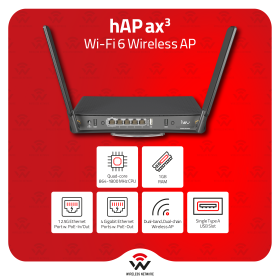
MikroTik Chateau PRO ax Wi-Fi 6 AX3600 4×4 MIMO Router
The MikroTik Chateau PRO ax is MikroTik's highest-performance home and office Wi-Fi 6 router — AX3600 dual-band Wi-Fi 6 with 4×4 MIMO on both 2.4 GHz (1,148 Mbps, QCN-5024, 5 dBi) and 5 GHz (2,400 Mbps, QCN-5054, 6 dBi), quad-core ARM64 IPQ-8072A at 2.2 GHz, 1 GB RAM, 5× Gigabit Ethernet ports, passive PoE-out on Ether5 (up to 22.8W), USB 3.0 type-A (1.5A), RouterOS v7 License 6, DC jack 18–57V, 55W max, passive cooling, -40°C to +70°C, MTBF ~200,000 hours. CE, FCC, IC, EAC, and RoHS certified — fully IC-certified for Canadian sale. Includes 48V 1.35A power adapter.

We only offer IC Certified products. For international products, contact us.

Ship Charge Will Display As Free Until Ship Address / Location Is Provided To Calculate Ship Charge.
The MikroTik Chateau PRO ax is not a mainstream consumer router with RouterOS installed. It is a purpose-built advanced home and office router designed for users who have outgrown the performance limits of dual-chain Wi-Fi — users who run homelabs, self-host containers, manage VPN tunnels, operate bonded WAN connections, or simply want the maximum available Wi-Fi 6 throughput from a single desktop device without building a rack-mount network. With RouterOS v7 License 6, AX3600 Wi-Fi 6, and a quad-core ARM64 CPU at 2.2 GHz, it is positioned as the flagship Chateau product — above the Chateau LTE18 ax in CPU performance and Wi-Fi capability, without the LTE modem of the LTE variant.
The AX3600 Wi-Fi 6 classification is derived from the combined maximum data rates of both radios: 1,148 Mbps on 2.4 GHz and 2,400 Mbps on 5 GHz. These numbers require 4×4 MIMO client devices to achieve — the Chateau PRO ax has four spatial stream transmit and receive chains on each band, and realising the full 1,148 Mbps at 2.4 GHz or 2,400 Mbps at 5 GHz requires a client device that also supports four spatial streams. MikroTik states this explicitly and it must be restated on the product page without ambiguity: a standard dual-chain (2×2) laptop or smartphone will achieve the same 2×2 throughput it achieves with any other 2×2 AP — the Chateau PRO ax's four-chain radios deliver their full advantage on four-chain clients, and improved beamforming, spatial diversity, and MU-MIMO performance on two-chain and single-chain clients.
The practical benefits of 4×4 MIMO for a mixed-client household or small office are threefold. First, beamforming performance improves significantly — four transmit chains provide the Chateau PRO ax with a four-element antenna array for beamforming, which focuses RF energy toward individual clients with greater precision than a two-element array, improving per-client signal quality and throughput at range. Second, MU-MIMO performance improves — with four spatial streams available, the Chateau PRO ax can serve four simultaneous single-stream clients, two simultaneous two-stream clients, or one four-stream client — all without the head-of-line blocking that single-stream MU-MIMO implementations create on heavily loaded dual-chain APs. Third, coverage improves — four antenna elements per band provide greater spatial diversity, reducing the null points and dead zones in the radiation pattern that two-element arrays create. For a three-bedroom home, a large open-plan office, or a multi-room homelab, the four-chain coverage improvement is perceptible without requiring a four-chain client device.
The IPQ-8072A CPU is the hardware differentiator that separates the Chateau PRO ax from every other Chateau in the product line. The quad-core ARM64 IPQ-8072A runs at 2,208 MHz — the highest CPU clock speed in the MikroTik Chateau product family and significantly faster than the IPQ-6010 at 1,800 MHz in the Chateau LTE18 ax. The IPQ-8072A includes a dedicated hardware crypto engine for IPsec — the Chateau PRO ax handles IPsec VPN encryption and decryption at hardware line rate without CPU load, meaning a site-to-site IPsec VPN tunnel or a remote access VPN does not reduce available CPU for other RouterOS functions. For advanced users running WireGuard, IPsec, L2TP, or OpenVPN on the same device that handles firewall rules, container workloads, and QoS policies, the IPQ-8072A's multi-core performance at 2.2 GHz provides the headroom that previous-generation MIPS and lower-clock ARM platforms cannot.
RouterOS v7 License 6 is the highest RouterOS licence tier in the home and office product line — it includes capabilities not available on License 4 devices: unlimited OSPF/BGP routes, unlimited EoIP tunnels, unlimited PPP tunnels, unlimited hotspot users, and the full advanced routing feature set. For advanced home users running multi-WAN bonding, BGP-based routing, or complex hotspot deployments, License 6 is the correct tier. For standard home and small office use, the additional License 6 capabilities are not needed — but they are included and available at no additional cost. The RouterOS v7 container feature (running Docker-compatible Linux containers directly on RouterOS) is available on arm64 License 6 devices — the Chateau PRO ax is the correct platform for running containerised applications (network monitoring, DNS ad-blocking, custom services, development environments) alongside the RouterOS routing and Wi-Fi functions on a single device.
The USB 3.0 Type-A port at 1.5A current output is the NAS enablement feature. USB 3.0 provides sufficient bandwidth for sequential read and write speeds of external SSDs — plug in a USB 3.0 SSD and configure RouterOS's SMB server to share the drive across the network, creating a basic NAS without additional hardware. For a home user who wants network-attached storage without purchasing a dedicated NAS device, the Chateau PRO ax with a USB SSD is a direct cost reduction. MikroTik's own product description names this use case explicitly. The 1.5A current output (higher than the 1A on the Chateau LTE18 ax) supports bus-powered 2.5-inch USB SSDs without a separate power supply. The USB port also supports LTE modem attachment — a USB LTE dongle on the USB port provides LTE backup WAN connectivity when the primary WAN connection fails, with RouterOS failover scripting managing the switchover automatically.
The passive PoE-out on Ether5 (up to 57V passive, 22.8W total output, 600 mA LV / 500 mA HV current limits) powers one downstream passive PoE device — a MikroTik outdoor AP, a PoE-powered IP camera, or any passive PoE-compatible device — directly from the Chateau PRO ax without a separate PoE injector. For a home office deployment where a single outdoor or ceiling-mount AP is needed beyond the Chateau's own Wi-Fi coverage, the PoE-out on Ether5 eliminates the need for a separate PoE injector purchase. Note that Ether5 passive PoE — not 802.3af/at — requires a passive PoE-compatible device on the other end. Active 802.3af/at devices may be damaged by passive PoE at voltages above their rated input — confirm passive PoE compatibility with the downstream device before connecting.
The five Gigabit Ethernet ports are unallocated in terms of WAN/LAN designation — RouterOS configures WAN and LAN assignments in software. Standard configuration: one port as WAN (connected to the ISP modem or fibre ONT), four ports as LAN switch. For multi-WAN deployments — two ISP connections bonded or failed over — two ports are configured as WAN inputs and three as LAN. The flexibility is in RouterOS, not in hardware — every port is functionally identical except Ether5's passive PoE-out capability.
**Canadian market note:** The Chateau PRO ax carries CE, FCC, IC, EAC, and RoHS certifications — the complete certification set including IC (ISED). This is the second fully IC-certified Wi-Fi device in this product batch after the Groove 52. **No Canadian certification advisory is required.** List with confidence for the Canadian market.
Key specifications:
- **Wi-Fi 2.4 GHz:** 802.11b/g/n/ax, Wi-Fi 6, 4-chain, 1,148 Mbps max, 5 dBi, QCN-5024
- **Wi-Fi 5 GHz:** 802.11a/n/ac/ax, Wi-Fi 6, 4-chain, 2,400 Mbps max, 6 dBi, QCN-5054
- **Wi-Fi speed class:** AX3600
- **Wi-Fi security:** WPA3 (standard across RouterOS v7 Wi-Fi 6 devices)
- **Ethernet:** 5× 10/100/1000 Mbps Gigabit Ethernet
- **PoE-out:** Passive PoE up to 57V on Ether5 — 600 mA LV / 500 mA HV, 22.8W total output
- **USB:** 1× USB 3.0 Type-A, 1.5A max, USB Power Reset supported
- **CPU:** IPQ-8072A, quad-core ARM64, 2,208 MHz
- **Switch chip:** IPQ-8072
- **RAM:** 1 GB
- **Storage:** 128 MB NAND
- **OS:** RouterOS v7, License 6
- **DC jack input:** 18–57V
- **Max power consumption:** 55W (with attachments), 18W (without)
- **Cooling:** Passive
- **IP rating:** IP20 (indoor installation only)
- **Operating temperature:** -40°C to +70°C
- **MTBF:** ~200,000 hours at 25°C
- **CPU temperature monitor:** Yes
- **PCB temperature monitor:** Yes
- **Voltage monitor:** Yes
- **Mode button:** Yes
- **Certifications:** CE, FCC, IC, EAC, RoHS — fully IC-certified for Canadian sale
- **Included:** 48V 1.35A power adapter
- **Product code:** H53UiG-5HaxQ2HaxQ
Note: 4×4 MIMO maximum data rates require a 4-chain client device — standard 2×2 laptops and smartphones achieve 2×2 throughput. Passive PoE-out on Ether5 is not 802.3af/at — confirm passive PoE compatibility with downstream devices before connecting. IP20 rated — indoor installation only.

- Product code
- H53UiG-5HaxQ2HaxQ
- Architecture
- ARM 64bit
- CPU
- CPU Quad-Core IPQ-8072A 2208 MHz
- CPU nominal frequency
- 8072A 2208 MHz
- Operating System
- RouterOS
- Size of RAM
- 1 GB
- Storage size
- 128 MB
- Storage type
- NAND
- Tested ambient temperature
- -40°C to 70°C
- Number of DC inputs
- 1 (DC jack)
- DC jack input Voltage
- 18-57 V
- Max Power consumption
- 55 W
- Max power consumption without attachments
- 18 W
- Cooling type
- Passive
- 10/100/1000 Ethernet ports
- 5
- Dimensions
- 240 x 156 x 44 mm
- Number of USB ports
- 1
- USB Power Reset
- Yes
- USB slot type
- USB type A
- Max USB current (A)
- 1
- Wireless 2.4 GHz number of chains
- 2
- Wireless 2.4 GHz standards
- 2.4 GHz 802.11b/g/n/ax
- Wireless 2.4 GHz chip model
- QCN-5024
- Wireless 5 GHz number of chains
- 2
- Wireless 5 GHz standards
- 5 GHz 802.11a/n/ac/ax
- Wireless 5 GHz chip model
- QCN-5054
- Antenna gain
- 2.4 GHz - 5 dBi, 5 GHz - 6 dBi
- Wireless 5 GHz generation
- Wi-Fi 6