
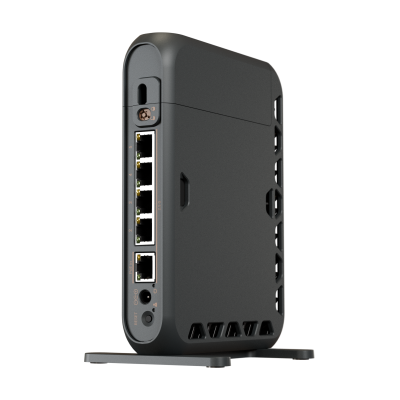


MikroTik hAP be3 Media Wi-Fi 7 Router MA53UG+HbeH
The MikroTik hAP be³ Media (MA53UG+HbeH) is a professional all-in-one Wi-Fi 7 router and media hub with triple-band 2×2 MIMO wireless, five 2.5G Ethernet ports, built-in Thread radio, Bluetooth 5.4, Matter/IoT support, and a quad-core ARM CPU with 2 GB RAM. It supports container workloads, microSD storage, USB-C and two USB-A ports, and runs RouterOS v7 License Level 6 — built for homes, home offices, network labs, and privacy-first self-hosted deployments without subscriptions or paywalls.

We only offer IC Certified products. For international products, contact us.

Ship Charge Will Display As Free Until Ship Address / Location Is Provided To Calculate Ship Charge.
The MikroTik hAP be³ Media (MA53UG+HbeH) is not just a router. It is a full-stack networking and media platform — combining Wi-Fi 7 tri-band wireless, five 2.5G Ethernet ports, a built-in Thread radio, Bluetooth 5.4, container support, and local storage in a single passively cooled device. No subscriptions. No paywalls. You buy it — you own it.
Wi-Fi 7 across all three bands delivers higher throughput, lower latency, and better spectral efficiency compared to Wi-Fi 6. The clean 6 GHz band reduces congestion in dense environments. Multi-Link Operation (MLO) in TR-MLMR (AP mode) enables smarter band aggregation and more resilient connections across workstations, VR headsets, NAS backups, cloud sync, and high-resolution media streaming simultaneously.
Key features:
- Triple-band Wi-Fi 7 (2×2 MIMO on all bands)
- 2.4 GHz — 574 Mbps, 802.11b/g/n/ax/be, 4 dBi
- 5 GHz — 1,200 Mbps, 802.11a/n/ac/ax/be, 7.5 dBi
- 6 GHz — 5,764 Mbps, 802.11ax/be, 8 dBi
- Wi-Fi 7 MLO (TR-MLMR) in AP mode
- 5× 2.5G Ethernet ports — no bottlenecks on ISP uplink, NAS, or workstations
- Built-in Thread radio — local Matter/IoT automation without cloud dependency
- Bluetooth 5.4 — BLE sensor integration and MikroTik BTH app support
- 1× USB-C + 2× USB-A (USB 3.0, up to 1.5A) + microSD card slot
- Container support — one-click setup in WinBox for dashboards, security tools, local AI assistants, and more
- Dual power inputs — DC jack (24–57V) and PoE-in (802.3af/at, 24–57V)
- Quad-core IPQ-5322 ARM 64-bit CPU, up to 1.5 GHz, 2 GB RAM, 512 MB NAND
- Passive cooling, -30°C to +50°C, MTBF ~200,000 hours at 25°C
- RouterOS v7, License Level 6 — free updates for life (minimum 5 years)
- Certified CE, FCC, IC, EAC, RoHS | IP20
In the box: 24V 1.5A power adapter, hAP be³ Case Base, MT Torx (T30 PIN).
Ideal for: home offices, network labs, privacy-first self-hosted setups, smart home and IoT deployments, NAS and media server environments, workstations requiring 2.5G connectivity, and anyone running containers or local services who wants everything managed from one device.

- Product code
- MA53UG+HbeH
- CPU architecture
- ARM 64bit
- CPU
- Quad-core IPQ-5322 up to 1.5 GHz
- Switch chip model
- QCA8386
- Operating System
- RouterOS v7, License level 6
- Size of RAM
- 2 GB
- Storage size
- NAND 512 MB
- Number of DC inputs
- 2 (DC jack, PoE-In)
- DC jack input Voltage
- 24-57 V
- Max Power consumption
- 29 W
- Dimensions
- 187 x 142 x 95 mm
- Number of USB ports
- 3 (1 USB Type C + 2x USB 3.0 Type A)
- Operating Temperature
- -30°C to +50°C
- RAM type
- DDR4
- Number of 2.5G Ethernet ports
- 5 (1 port with PoE-in)
- Bluetooth version
- 5.4
- Power adapter nominal voltage
- 24 V
- Power adapter nominal current
- 1.5 A
- PoE-In
- 802.3af/at
- PoE-In input Voltage
- 24-57 V
- Max power consumption (without attachments)
- 20 W
- Wireless interface model (2.4 GHz)
- IPQ-5322
- Wireless interface model (5 GHz)
- QCM-8083
- Wireless interface model (6 GHz)
- QXM-8086
- Supported protocol (2.4 GHz)
- 802.11b/g/n/ax/be
- Supported protocol (5 GHz)
- 802.11a/n/ac/ax/be
- Supported protocol (6 GHz)
- 802.11ax/be
- Antenna gain (2.4 GHz)
- 4 dBi
- Antenna gain (5 GHz)
- 7.5 dBi
- Antenna gain (6 GHz)
- 8 dBi