MikroTik L009UiGS-RM 8×GbE 2.5G SFP ROS v7 Router
The MikroTik L009UiGS-RM is a compact rackmount ARM router — dual-core ARM32 IPQ-5018 at 800 MHz, Marvell 88E6190 switch chip, 512 MB RAM, 128 MB NAND, RouterOS v7 License 5, 8× Gigabit Ethernet ports (Ether1: 802.3af/at PoE-in 24–56V; Ether8: passive PoE-out 1A), 1× SFP port (2.5G supported), 1× USB 3.0 Type-A (max 1.5A, USB Power Reset), RJ45 serial console, DC jack 24–56V, 40W max consumption, passive cooling (heatsink enclosure), IP20, -40°C to +70°C, MTBF ~200,000 hours at 25°C. CE, EAC, RoHS certified. Includes 24V 1.5A power adapter, rackmount kit K-79, K-55 screw kit, K-87, adhesive pads.

We only offer IC Certified products. For international products, contact us.

Ship Charge Will Display As Free Until Ship Address / Location Is Provided To Calculate Ship Charge.
The MikroTik L009UiGS-RM is the definitive upgrade to the RB2011 — MikroTik's most widely deployed affordable router platform of the past decade — rebuilt from the ground up on a modern ARM architecture with substantially higher performance, more RAM, hardware IPsec acceleration, container support, a 2.5G SFP port, and an innovative rack enclosure that allows four units to occupy a single 1U rack space. For any network operator currently running RB2011 units as ISP CPE, edge routers, office routers, or home lab devices, the L009UiGS-RM is the direct migration path.
**Why the L009 replaces the RB2011**
The RB2011 was built on the MIPS architecture — the same CPU platform as the wAP LR2 kit's QCA9531 (single-core, 650 MHz, 64 MB RAM). The L009UiGS-RM's IPQ-5018 is a dual-core ARM32 at 800 MHz with 512 MB RAM — a completely different performance tier. MikroTik quantifies the improvement directly: the L009 is up to 4× faster than the RB2011 across routing, firewall filtering, and bridge filter workloads. The practical meaning of "4× faster" in a router context:
- **Routing throughput:** Fast path routing on the L009 handles significantly more packets per second than the RB2011 — relevant for ISP CPE deployments where the router must sustain 500 Mbps–1 Gbps WAN-to-LAN throughput under load without CPU saturation.
- **Firewall rule processing:** Complex firewall rule sets — connection tracking, Layer 7 DPI, address list matching, mangle rules — consume CPU cycles proportional to rule count and traffic rate. The L009's dual-core ARM CPU processes these rules at 4× the throughput of the RB2011, allowing more complex security policies without performance degradation.
- **IPsec hardware encryption (60–90 Mbps at 1,400 byte packets):** The IPQ-5018 includes hardware IPsec acceleration. MikroTik specifies approximately 60–90 Mbps IPsec throughput at 1,400 byte packet size — a meaningful capability for any deployment using site-to-site IPsec VPN tunnels or WireGuard VPN. For an ISP CPE use case where the customer requires an IPsec tunnel from the premises router to a corporate head office, the L009's hardware IPsec acceleration handles the encryption workload without measurable CPU impact on concurrent routing performance.
**The Marvell 88E6190 switch chip — 2.5G full duplex connection to CPU**
The Marvell 88E6190 is the switch chip managing Ethernet ports 2–8 and the SFP port — with a critical architecture detail that MikroTik specifically highlights: the 88E6190 provides a 2.5 Gigabit full duplex connection to the CPU for all ports except Ether1. Ether1 has its own dedicated 1 Gigabit full duplex connection to the CPU. This split architecture has a direct operational consequence: there is no shared bottleneck between the switch fabric and the CPU.
In a traditional router where the switch chip connects to the CPU over a single shared uplink, all inter-VLAN routing traffic between ports must traverse that single uplink — and if the uplink is saturated, all inter-VLAN routing stalls regardless of the individual port speeds. The L009UiGS-RM's 2.5 Gbps switch-to-CPU connection is wider than any individual Gigabit Ethernet port — meaning a single port cannot saturate the switch-to-CPU path. For a deployment where the L009UiGS-RM performs inter-VLAN routing between multiple Gigabit VLANs simultaneously — production, management, guest, storage — the 2.5G switch-to-CPU connection ensures the routing bottleneck is the individual 1G port speeds, not the internal bus. The 2.5G SFP port connects to the same 88E6190 switch fabric — a 2.5GBASE-T or 2.5G SFP DAC connection to a NAS, upstream switch, or fibre handoff operates at full 2.5G without internal bottleneck.
**PoE-in and PoE-out — flexible power architecture**
The L009UiGS-RM provides two independent power input methods and one power output:
- **Ether1 PoE-in (802.3af/at, 24–56V):** The primary PoE power input — a single Ethernet cable from a PoE switch port or PoE injector carries both the network uplink and power. The 802.3af/at standard covers both passive PoE from a 24V source and standard active PoE from a 48V PoE switch. For a rack deployment where the upstream PoE switch provides 802.3af/at on its downlink ports, the L009UiGS-RM can be powered directly from the rack switch without a separate power adapter — simplifying cabling and eliminating one AC power feed per router.
- **DC jack input (24–56V):** The conventional DC power input — the included 24V 1.5A adapter plugs directly into the DC jack. For deployments without PoE infrastructure, or where PoE is reserved for other devices, the DC jack provides a direct power path.
- **Ether8 passive PoE-out (1A LV / 450 mA HV, 1A max total):** The eighth Ethernet port provides passive PoE output — powering a downstream Ethernet device from the L009UiGS-RM's power supply. The passive PoE-out voltage mirrors the input power voltage — if the L009UiGS-RM is powered at 24V, Ether8's passive PoE-out is 24V. For a deployment where a compact IP camera, a Wi-Fi AP, or a sensor device needs power at the same location as the L009UiGS-RM, Ether8's PoE-out eliminates a separate power adapter for the downstream device. The 1A current limit at low voltage (LV) supports devices consuming up to approximately 24W (at 24V) from Ether8 — confirm downstream device power requirements against the 1A / 450 mA limits before relying on Ether8 PoE-out.
**Container support — ARM CPU + USB 3.0 = self-hosted services on the router**
The IPQ-5018's ARM32 architecture enables RouterOS v7's container feature — the ability to run Docker-compatible Linux container images directly on the router, in isolated user-space environments managed by RouterOS. Container support on RouterOS v7 is available on ARM and ARM64 devices only — MIPS devices like the RB2011 cannot run containers. The L009UiGS-RM's ARM CPU plus USB 3.0 Type-A port (1.5A) creates a practical self-hosted services platform:
- **Pi-hole (network-wide ad blocking):** MikroTik's own product page specifically calls out Pi-hole as a container use case — running the Pi-hole DNS sinkhole container on the L009UiGS-RM provides network-wide ad and tracker blocking for all devices on the local network, without a separate Raspberry Pi or server. For a home office or SMB deployment where the L009UiGS-RM is the primary router, Pi-hole in a container provides a quality-of-life improvement that the RB2011 could not deliver.
- **USB LTE modem WAN failover:** A USB LTE modem inserted into the USB 3.0 port provides automatic WAN failover when the primary Ethernet WAN link fails — exactly the same capability as the L11UG-5HaxD and mANTBox ax 15s. RouterOS failover scripting detects primary WAN failure and switches traffic to the USB LTE modem without manual intervention. The USB 3.0 port's 1.5A current rating supports high-current USB LTE modems reliably.
- **Custom network services:** RouterOS v7 containers support any ARM-compatible Linux container image — DNS resolvers (Unbound, AdGuard Home), monitoring (Prometheus, Grafana), VPN servers (WireGuard in container), network scanners, and custom automation services. The USB 3.0 port provides external storage for container images and data, expanding beyond the 128 MB NAND flash for container workloads.
**4× routers per 1U — the innovative enclosure**
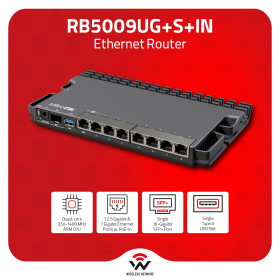
The L009UiGS-RM's enclosure is the same form factor as the RB5009UG+S+ — a slim, finned aluminium case where the enclosure itself acts as a passive heatsink. The enclosure's thermal mass and surface area dissipate the CPU and switch chip heat without a fan — the L009UiGS-RM is fully passive cooled at 40W max consumption and -40°C to +70°C operating range. No fan noise. No fan failure risk. No scheduled fan replacement.
The K-79 rackmount kit (included) enables four L009UiGS-RM units to mount side by side in a single standard 1U 19" rack space. Four routers, each with 8× Gigabit Ethernet + 1× 2.5G SFP + USB 3.0 + PoE-in/out, occupy 1U — a rack density no other MikroTik router platform matches at this price. MikroTik extends the density concept further: combining one RB5009UG+S+IN (with PoE-out ports to power downstream devices) with seven L009UiGS-RM units achieves eight router nodes in two 1U spaces, with the RB5009 providing PoE power to all seven L009 units via their Ether1 PoE-in ports. For ISP CPE staging racks, managed service provider (MSP) provisioning benches, or dense multi-tenant server rooms, this density model is genuinely novel at the L009's price point.
Adhesive pads included in the package allow the L009UiGS-RM to be desk- or shelf-mounted without rack infrastructure — the passive heatsink enclosure is a flat-bottomed aluminium chassis that sits stably on a desk surface. For a deployment where rack mounting is not required or available, the adhesive pads provide a clean, secure desktop installation.
**RouterOS v7 License 5**
RouterOS v7 License 5 on the L009UiGS-RM provides the full feature set: unlimited routing protocol instances (BGP, OSPF, RIP, MPLS), advanced QoS, WireGuard, L2TP/IPsec, OpenVPN, hotspot gateway, CAPsMAN controller, container, scripting, and SNMP. License 5 is the correct tier for ISP edge routers managing customer BGP sessions, MSP-managed office routers with complex VPN configurations, or home lab devices running advanced RouterOS features. The L009UiGS-RM delivers License 5 and is one of the most cost-effective RouterOS v7 License 5 devices in the current MikroTik catalogue.
**RJ45 serial console port**
The RJ45 serial console port provides direct out-of-band management access — a critical recovery path for any deployed router. If the network configuration renders the device unreachable via Ethernet (misconfigured firewall, incorrect IP addressing, VPN misconfiguration), the serial console provides a direct RouterOS CLI session independent of the network configuration. For an ISP deploying L009UiGS-RM units as customer premises equipment, the serial console allows the support technician to connect a USB-to-RJ45 serial adapter and recover the device's configuration without a factory reset.
**5-year software support guarantee:** RouterOS v7 updates free for life of product or minimum 5 years from date of purchase.
**Canadian market note:** Certifications are CE, EAC, and RoHS — no FCC or IC (ISED) published. The L009UiGS-RM is a wired router with no wireless transmitter. No ISED wireless certification advisory applies. Confirm any applicable Canadian electrical safety certification (CSA, cUL) requirements with your distributor before listing for Canadian customers. The absence of FCC/IC is not a compliance concern for a wired router in Canada — wired Ethernet devices are not subject to ISED wireless device certification requirements.
Key specifications:
- **Product code:** L009UiGS-RM
- **Architecture:** ARM 32-bit
- **CPU:** IPQ-5018, dual-core ARM32, 800 MHz
- **Switch chip:** Marvell 88E6190
- **RAM:** 512 MB
- **Storage:** 128 MB NAND
- **OS:** RouterOS v7, License 5
- **Gigabit Ethernet ports:** 8× (Ether1: 802.3af/at PoE-in; Ether8: passive PoE-out)
- **SFP port:** 1× (2.5G supported)
- **USB:** 1× USB 3.0 Type-A, max 1.5A, USB Power Reset
- **Serial console:** RJ45
- **DC jack input:** 24–56V
- **PoE-in:** 802.3af/at, 24–56V (Ether1)
- **PoE-out:** Passive PoE, Ether8, 1A LV / 450 mA HV, 1A max total
- **Max power consumption:** 40W
- **Max power without attachments:** 8W
- **Cooling:** Passive (heatsink enclosure)
- **IP rating:** IP20
- **Operating temperature:** -40°C to +70°C
- **MTBF:** ~200,000 hours at 25°C
- **Mode button:** Yes
- **Certifications:** CE, EAC, RoHS — no FCC, no IC published
- **Included:** 24V 1.5A power adapter, rackmount kit K-79, K-55 screw kit, K-87, adhesive pads
- **Rack density:** Up to 4× L009UiGS-RM per 1U (with K-79)

- Product code
- L009UiGS-RM
- Architecture
- ARM 64bit
- CPU core count
- 2
- CPU nominal frequency
- 800 MHz
- Switch chip model
- 88E6190
- Operating System
- RouterOS v7
- Size of RAM
- 512 MB
- Storage size
- 128 MB
- Storage type
- NAND
- Tested ambient temperature
- -40°C to 70°C
- Number of DC inputs
- 2 (DC jack, PoE-IN)
- DC jack input Voltage
- 24-56 V
- Max Power consumption
- 37 W
- Max power consumption without attachments
- 8 W
- Cooling type
- Passive
- PoE in
- 802.3af/at
- PoE in input Voltage
- 24-56 V
- PoE out
- Ether8
Passive PoE - Max out per port output - input (less than 30 V)
- 1A
- Max out per port output (input more than 30 V)
- 450 mA
- Max total out (A)
- 1A
- 10/100/1000 Ethernet ports
- 8
- SFP ports
- 1 (2.5G supported)
- Number of USB ports
- 1
- USB Power Reset
- Yes
- USB slot type
- USB 3.0 type A
- Max USB current (A)
- 1
- Certification
- CE, EAC, ROHS
- Mode button
- Yes
- IP
- 20
- Number of 1G Ethernet ports with PoE-out
- 1